The end of Daniel 9 has always bothered me. It seems to be written in some kind of indecipherable code language. In addition, it contains translation issues leading to a variety of interpretations. For some reason, though, I have been glued to this passage for the past few days and I am finally willing to tackle it.
Background
Here’s the background. As a young man Daniel was taken as a captive to Babylon in 605 BC. Chapter 9 begins almost 70 years later in 538 BC with Daniel still in Babylon. While reading the prophet Jeremiah, Daniel realizes that Jerusalem’s destruction would last seventy years. Jeremiah’s statements include the following:
This whole country will become a desolate wasteland, and these nations will serve the king of Babylon seventy years.
“But when the seventy years are fulfilled, I will punish the king of Babylon and his nation, the land of the Babylonians, for their guilt,” declares the LORD, “and will make it desolate forever. (25:11-12 NIV)
This is what the LORD says: “When seventy years are completed for Babylon, I will come to you and fulfill my good promise to bring you back to this place.” (29:10)
In response to Jeremiah’s promises and while near the end of the seventy-year period, Daniel turns to the Lord “with fasting and sackcloth and ashes” (ESV). After confessing the sins of Israel in verses 4-14, he pleads with God to forgive and turn away his wrath from Jerusalem in verses 15-19. While praying, Daniel says, Gabriel, “the man I had seen in the earlier vision, came to me in swift flight about the time of the evening sacrifice” (v. 22) so around 3 p.m. Who is this man named Gabriel?
Gabriel is no ordinary man. Here’s what happened in the previous chapter:
While I, Daniel, was watching the vision and trying to understand it, there before me stood one who looked like a man. And I heard a man’s voice from the Ulai calling, “Gabriel, tell this man the meaning of the vision.”
As he came near the place where I was standing, I was terrified and fell prostrate. “Son of man,” he said to me, “understand that the vision concerns the time of the end.”
While he was speaking to me, I was in a deep sleep, with my face to the ground. Then he touched me and raised me to my feet. (8:15-18 NIV)
So Gabriel can explain the meaning of Daniel’s vision, his appearance is breathtaking, and he is powerful. In the next chapter Gabriel comes flying in in response to Daniel’s prayer and says, “I have now come to give you insight and understanding” (v. 22). (By the way, just because he flies in doesn’t mean he has wings. If you are interested in the topic of angels and wings, see this post.) All of this shows that Daniel presents Gabriel as a powerful and knowledgeable spiritual being who communicates special messages to humans. In sum, he sounds like an angel.
Then why does Daniel call Gabriel a man? He must look like a man, but his attributes show that he is something more than a mere man. In particular, his abilities and function are angelic. In Scripture angels frequently appear as “men” so we shouldn’t be surprised that Gabriel is called a man (e.g., Gen 18-19; Gen 32 -> Hos 12:4; Lk 24:4; Jn 20:12). For this reason, it’s possible to show hospitality to angels without knowing it (Heb 13:2). In addition, the name Gabriel only appears four times in the Bible—twice in Daniel and twice in Luke. In Luke, Gabriel is the angel who foretold the births of John the Baptist and Jesus (1:19, 26). Hence, I believe we are safe in concluding that Gabriel is an angel.
After introductory remarks, Gabriel conveys this challenging message. (I have left the NIV footnotes to show some of the issues involved in this passage.)
Daniel 9:24-27
24 “Seventy ‘sevens’[c] are decreed for your people and your holy city to finish[d] transgression, to put an end to sin, to atone for wickedness, to bring in everlasting righteousness, to seal up vision and prophecy and to anoint the Most Holy Place.[e]
25 “Know and understand this: From the time the word goes out to restore and rebuild Jerusalem until the Anointed One,[f] the ruler, comes, there will be seven ‘sevens,’ and sixty-two ‘sevens.’ It will be rebuilt with streets and a trench, but in times of trouble. 26 After the sixty-two ‘sevens,’ the Anointed One will be put to death and will have nothing.[g] The people of the ruler who will come will destroy the city and the sanctuary. The end will come like a flood: War will continue until the end, and desolations have been decreed. 27 He will confirm a covenant with many for one ‘seven.’[h] In the middle of the ‘seven’[i] he will put an end to sacrifice and offering. And at the temple[j] he will set up an abomination that causes desolation, until the end that is decreed is poured out on him.[k]”[l] (NIV)
c. Or ‘weeks’; also in verses 25 and 26
d. Or restrain
e. Or the most holy One
f. Or an anointed one; also in verse 26
g. Or death and will have no one; or death, but not for himself
h. Or ‘week’
i. Or ‘week’
j. Septuagint and Theodotion; Hebrew wing
k. Or it
l. Or And one who causes desolation will come upon the wing of the abominable temple, until the end that is decreed is poured out on the desolated city
I will dive into the challenges in the next post. In this post I want to begin with the big picture. Gabriel’s message must have meant something to Daniel. What did it mean? What can we be sure of?
Big Picture
First, Daniel can comprehend this message. Gabriel says, “Daniel, I have now come to give you insight and understanding” (v. 22). Gabriel didn’t come to confuse Daniel. He tells Daniel, “consider the word and understand the vision” (v. 23). It may take work, but it’s possible for Daniel to comprehend the message.
Second, God has a plan for the people of Israel and the holy city. While Daniel is praying for the people of Israel and Jerusalem, Gabriel responds, “Seventy ‘sevens’ are decreed for your people and your holy city” (v. 24). Since the angel Gabriel is talking about a decree, it is safe to assume this is a divine decree. Most scholars—Jewish and Christian—agree that the weeks of Daniel 9 should be viewed as years. (More on this in the next post.) Taking the “weeks” as “years” results in 490 years. Hence, Gabriel was reassuring Daniel that there was a plan and timetable for his people and his holy city. And the timetable was much longer than their years of captivity—instead of seventy, there would be seventy sevens.
Third, the problem of sin will be solved. Daniel’s prayer is filled with confession of sin and a plea for divine mercy.
Lord, the great and awesome God, who keeps his covenant of love with those who love him and keep his commandments, we have sinned and done wrong. We have been wicked and have rebelled; we have turned away from your commands and laws. We have not listened to your servants the prophets, who spoke in your name to our kings, our princes and our ancestors, and to all the people of the land.
“Lord, you are righteous, but this day we are covered with shame—the people of Judah and the inhabitants of Jerusalem and all Israel, both near and far, in all the countries where you have scattered us because of our unfaithfulness to you. We and our kings, our princes and our ancestors are covered with shame, Lord, because we have sinned against you. The Lord our God is merciful and forgiving, even though we have rebelled against him; we have not obeyed the Lord our God or kept the laws he gave us through his servants the prophets. All Israel has transgressed your law and turned away, refusing to obey you. (vv. 4-11)
Lord, listen! Lord, forgive! Lord, hear and act! For your sake, my God, do not delay, because your city and your people bear your Name.” (v. 19)
Then Gabriel appears and says that within a certain time period the following goals will be achieved:
- to finish transgression,
- to put an end to sin,
- to atone for wickedness,
- to bring in everlasting righteousness,
- to seal up vision and prophecy, and
- to anoint the Most Holy Place. (The Hebrew text only says, “to anoint the Most Holy” so some argue it should be translated “to anoint the Most Holy One.”) (v. 24)
Old Testament priests offered continual sacrifices for atonement or reconciliation with God. But Gabriel’s message makes it sound like sin is dealt with once and for all. We see this not only in the finality of the phrases—“to finish transgression . . . to put an end to sin,” etc. but in the generality of his words. Jacques Doukhan writes,
The fact is striking: All those words which are used in the prayer in a definite sense expressing a particularist view (“our,” “my,” “of the people,” “of God,” etc.) are suddenly, as soon as they appear in the context of the 70 weeks, used in an indefinite sense expressing a universalistic point of view. (21)
For example, “to put an end to sin” is not limited to Israel’s sin. So Gabriel encourages us to think in more universal terms about humanity’s problem of sin. In short, the seventy sevens would have a monumental impact on sin, sacrifice, and righteousness in the world.
Fourth, Jerusalem will be rebuilt. Daniel prays, “turn away your anger and your wrath from Jerusalem, your city, your holy hill . . . open your eyes and see the desolation of the city that bears your Name . . . For your sake, my God, do not delay, because your city and your people bear your Name” (vv. 16-19). Gabriel promises that the word will go out “to restore and rebuild Jerusalem” and “It will be rebuilt with streets and a trench” (v. 25). While Gabriel doesn’t mention the rebuilding of the temple, it is part of the rebuilding of the city. Moreover, verse 26 says it will be destroyed with the city so it must have been rebuilt. The Second Temple was completed in 515 BC under the leadership of Zerubbabel.
Fifth, an anointed one will come. Daniel doesn’t mention an anointed one or Messiah in his prayer, but Gabriel draws his attention to this figure so he must be significant. In the Old Testament both priests and kings were anointed with oil. This set them apart for their leadership roles. In context the anointed one must have something to do with answering Daniel’s prayer and achieving the goals of verse 24. This anointed one is also called “ruler” (v. 25 NIV) or “prince” (ESV, NET). According to Gabriel, the first time period begins with the word to rebuild Jerusalem and ends with the anointed one.
Sixth, this anointed one will be killed. He will “put to death” (v. 26 NIV) or “cut off” (ESV). Is this the same anointed one in verse 25? Most likely. Gabriel has just mentioned an anointed one and now he does so again and there is no indication that they are two different people. Moreover, Doukhan argues from the structure of the passage that it must be the same person. The passage moves from the rebuilding of Jerusalem to the destruction of Jerusalem and from the Anointed One to the death of the anointed One (17-18). Since it’s the same city, it must be the same Anointed One.
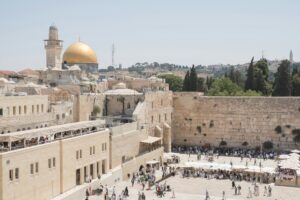
Seventh, the temple and Jerusalem will be destroyed. Gabriel says, “The people of the ruler who will come will destroy the city and the sanctuary” (v. 26). So Jerusalem will be rebuilt then it will be destroyed again. From verse 27 it appears that the coming destruction will involve an “abomination that causes desolation.” This phrase is used two more times in Daniel in connection with the temple: “His armed forces will rise up to desecrate the temple fortress and will abolish the daily sacrifice. Then they will set up the abomination that causes desolation” (11:31) and “From the time that the daily sacrifice is abolished and the abomination that causes desolation is set up, there will be 1,290 days” (12:11). The destruction of Jerusalem and the temple occurred under the direction of the Roman general Titus in AD 70.
While the passage ends on a depressing note, it begins with the six positive goals of verse 24. So the negative events must serve a positive purpose.
I will fill in the details in the next post.

After graduating from Gordon-Conwell Theological Seminary, I served as a Bible and theology teacher in Asia and the U.S. My new book explores the amazing doctrine of the Trinity.
Discover more from BibleBridge
Subscribe to get the latest posts sent to your email.
Hello Les Great to see you doing end times now! So many signs and world events coming closer and closer together. We are seeing changes I never thought I would see in my remaining short lifetime! World politics drifting toward socialism (one world government) Violence and lying universally increasing etc. The one thing standing out to me the spiritual evidence shown by the large percentages of people worldwide showing hatred for Israel for absolutely no logical reason! It is vividly obvious in their support for “Palistine” large demonstrations against Israel. The people doing it cannot give any reason why they are doing it….I don’t think they KNOW why. I think it is a spiritual thing controlled by satan ….possibly getting ready for an appearence to “save’ the world from total destruction by warfare or a I …. etc. ? Anti Christ ?