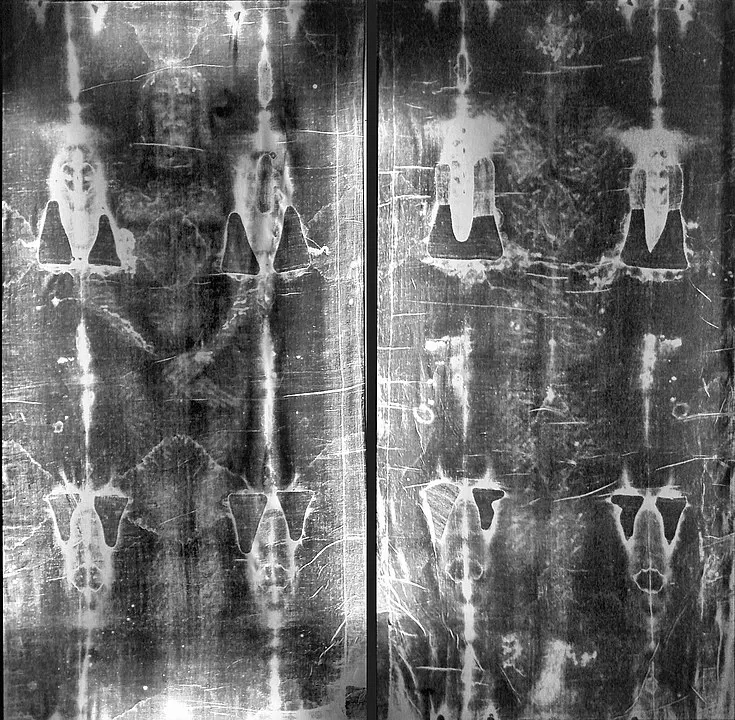
The Shroud of Turin is the most studied artifact in the world. This ancient piece of linen, located in Turin, Italy, measures 14 feet 3 inches long by 3 feet 7 inches wide and contains something remarkable—a full-length front and back image of a scourged and crucified man. (For high definition photos, click here.) Some think the Shroud is the actual burial cloth of Christ; others think it is a medieval forgery. Who’s right?
Biblical Data
- Here’s what the four Gospels say about Jesus’ burial wrappings:
-
- “Joseph took the body, wrapped it in a clean linen cloth.” (Matt 27:59 NIV)
-
- “Joseph bought some linen cloth, took down the body, wrapped it in linen.” (Mk 15:46)
-
- Joseph “took it down, wrapped it in linen cloth.” (Lk 23:53)
-
- “Taking Jesus’ body, the two of them [Joseph of Aramathea and Nicodemus] wrapped it, with the spices, in strips of linen. This was in accordance with Jewish burial customs” (Jn 19:40). (Most versions say, “linen cloths” instead of “strips of linen.”) After seeing the empty tomb, Mary Magdalene told Peter and “the other disciple” then Peter and the other disciple headed to the tomb:
Both of them were running together, but the other disciple outran Peter and reached the tomb first. And stooping to look in, he saw the linen cloths lying there, but he did not go in. Then Simon Peter came, following him, and went into the tomb. He saw the linen cloths lying there, and the face cloth, which had been on Jesus’ head, not lying with the linen cloths but folded up in a place by itself. Then the other disciple, who had reached the tomb first, also went in, and he saw and believed. (Jn 20:4-8 ESV)
- As you can see, the Gospel of John gives the most detail about the burial cloths. (Some believe the Sudarium of Oviedo is the head or face cloth mentioned in John 20. This post will focus on the Shroud of Turin.)
- The image on the Shroud corresponds with the sufferings of Jesus of Nazareth and especially with the Gospel of John’s account. Here are seven points of correspondence:
-
- scourge marks all over body (Jesus was flogged – Jn 19:1; the marks on the Shroud are consistent with a Roman flagrum)
- crucifixion wounds (these wounds are in the wrist and heel, which is medically accurate for crucifixions – Jn 19:18)
- blood coming from head (crown of thorns – Jn 19:2)
- swelling on face (soldiers hit Jesus in the face – Jn 19:3)
- legs not broken (Jn 19:33)
- puncture wound in side (Jn 19:34)
- no decomposition – Jesus was crucified on Friday and rose from the dead on Sunday (Jn 20:1-18)
- What happened to the burial items after Peter and John saw them? The Bible doesn’t give us any more information. However, based on human nature, I cannot imagine Peter and John leaving their Lord’s burial cloths in the tomb. If they didn’t retrieve the items, I think they would have made sure someone else did.
Jewish Custom
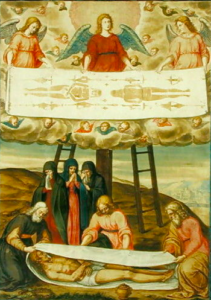
- Some think the Shroud cannot be the actual burial cloth of Jesus because it is one large sheet while the Bible says he was wrapped in “linen cloths” or “strips of linen.” In response, Barrie Schwortz writes, “Jewish custom requires burial in a large single sheet, as demonstrated in the accompanying De la Rovere painting. Once the body is wrapped in the cloth, it must be bound by linen strips to insure the cloth does not fall off when the body is transported. That is not only consistent with a first century Jewish burial, but also with contemporary burials, and not just by Jews but by Muslims as well. When my father died in 2003, he was given an Orthodox Jewish burial and was wrapped in a white linen shroud very similar to the Shroud of Turin. When the disciples entered the tomb on Sunday morning, only the cloth and strips remained, so they are mentioned in the Gospels.
Of course, the Gospels also tell us there was a second cloth, folded and separate from the other. I often am told that, since the Shroud is only one cloth and two were mentioned in scripture, that the Shroud must consequently be a fake. . . .
So what is this second cloth and why was it there? Once again, Jewish law requires that anything containing the victim’s blood or bodily fluids be buried with the body. Once Jesus was taken down from the cross, his face and head were wrapped in a smaller cloth or napkin which absorbed the blood and pleural fluids from his nose and mouth. We still follow a similar procedure today and typically cover the face of the dead immediately upon their passing. Frankly, it is the preservation of this second cloth and its presence in the tomb that convinces me this was an authentic Jewish burial. Even more amazing is that this second cloth, known as the Sudarium, has survived to the present day and is now kept in the cathedral in Oviedo, Spain, where it has resided since the 7th century!” (https://www.nationalshroudofturinexhibit.org/about_the_shroud)
Provenance
- It’s possible for linen to survive for several millennia. The oldest known linen dress is called the Tarkhan dress, which is more than 5,000 years old.
- Some believe Jesus’ burial shroud has survived and is now located in Turin, Italy. This is known as the Shroud of Turin.
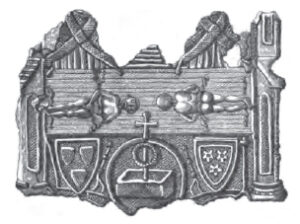
- We do not have a chain of custody or provenance for the Shroud of Turin prior to the 1300s. This fosters doubt as to its authenticity. The general consensus is that we can trace the Shroud to the 1350s when it was owned by the French knight Geoffroi de Charny and his wife, Jeanne de Vergy. They first publicly exhibited the cloth in a collegiate church in Lirey, France in 1355. The Lirey Pilgrim Badge was created to commemorate the exhibition. Where was the Shroud prior to the 1350s? The best we can do is propose theories.
- It could not have been called the Shroud of Turin prior to 1578 when the House of Savoy moved it to the Cathedral of Saint John the Baptist in Turin, Italy. Some think it was known as the Image of Edessa or the Mandylion, but others believe there are are serious problems with this theory. (For more details, click here.)
History & Studies
- Modern sindonology began on May 28, 1898 when Secondo Pia, an amateur photographer, took the first successful photograph of the Shroud. After developing the film, Pia was the first person to see the positive image of the Shroud, thus revealing that the Shroud contains a negative image. Here are his words, “Closed in the dark room, all intent upon my work, I felt a strong emotion when, during the development, I first saw appearing the Holy Face on the plate, with so much emphasis that I was surprised and together cheerful since I could from that moment be sure about the good result of my enterprise” (shroud.com). Some accused Pia of fraud, claiming that he doctored the image.
- In May 1931 Giuseppe Enrie, a professional photographer, took photographs of the Shroud and received similar results to Pia’s, which vindicated Pia’s work.
- In 1973 “Max Frei, a noted Swiss criminologist, was given permission to take dust samples from the Shroud that contained numerous pollen spores. He discovered 22 pollen species from plants unique to areas around Constantinople and Edessa (where the Shroud was thought to have traveled after leaving Jerusalem), as well as seven pollen species from plants common only in Israel. The pollen trail appears to corroborate the historic trail.” (https://www.nationalshroudofturinexhibit.org/about_the_shroud)
- In 1978 the Shroud of Turin Research Project or STURP was established. The STURP team included about 30 scientists who studied the Shroud “for five continuous days using state-of-the-art technology at the time.” During this time ultraviolet photographs were taken. After analyzing the data for three years, the scientists produced this statement:
We can conclude for now that the Shroud image is that of a real human form of a scourged, crucified man. It is not the product of an artist. The bloodstains are composed of hemoglobin and also give a positive test for serum albumin. The image is an ongoing mystery, and until further chemical studies are made, perhaps by this group of scientists, or perhaps by some scientists in the future, the problem remains unsolved. (https://www.shroud.com/78conclu.htm)
- Why did STURP arrive at this conclusion? Here’s what they discovered about the Shroud:
-
-
- No substances manually applied to the cloth.
- No artistic substances such as paint, ink, dye, pigments, or stain were used to constitute the image.
- No collagen binder as would be used with paint.
- No fibers cemented to each other as with paint.
- No capillary action — meaning no liquids were applied to form the image.
- No substances found between threads, as with a dust rubbing.
- Bloodstains on cloth test positive for heme, bile, serum albumin, and other human blood components. The blood is male type AB.
-
Here are more features of this spectacular image:
-
-
- The image is purely superficial. It does not penetrate the cloth – only rests on the top two micro-fibers. (Analogous to an image resting on the hairs of your forearm.)
- The image is a photographic negative that develops as a positive.
- The image contains 3D “distance information” similar to a topographical map. No photograph has this feature. This shows it was wrapped around a human body.
- No directionality to the image, as found with a brush or any substance application tool.
- No variation in the depth of the image. (Virtually impossible with human hands.)
- The yellowing of the image is uniform in intensity.
- No outline or defined edges to the image. (https://www.nationalshroudofturinexhibit.org/about_the_shroud)
-
- The top two features alone listed above—superficiality and negativity—are highly impressive. Why and how would anyone create an extremely superficial negative image 300 years before the invention of photography? The first photograph, called the View from the Window at Le Gras, was taken in 1826. The image on the Shroud can only be clearly seen as a positive image when developed as a photograph.
- The Shroud has survived two fires which explains its scorch marks—1532 in Chámbery, France and 1997 in Turin, Italy.
- Upon his death in 1983 King Umberto II bequethed the Shroud to the pope and his successors with the provision that it remains in Turin, Italy.
- In 1988, “A small corner of the Shroud was cut and radiocarbon dated (C-14) by three laboratories in Oxford, Zurich, and Arizona. The labs determined a date range from between 1260 to 1390.” The scientists involved concluded that the Shroud is a medieval artifact with 95% certainty. However, the image does not match the work of any known medieval artist because the man is completely nude, the wound is in the wrist not the hand, and it is a full length front and back negative image.
- “Since 1989, scholars interested in the TS [Turin Shroud] have often requested the raw data from the laboratories, without success (Pourrat 1991). This denial of access led to controversy and hindered the assessment of the analysis performed by the British Museum (Marinelli 2012; Rinaldi 2012). In 2017, several Freedom of Information Act (FOIA) requests to the institutions involved in the TS radiocarbon dating were made. The British Museum replied favourably and made all its files, ‘not dated or arranged in any order’, available.” Researchers who have studied the raw data have found significant discrepancies calling into question the validity of the 1988 tests. (See here.)
- According to a paper published in 2022, the results of a Wide-Angle X-ray Scattering (WAXS) experiment showed that the Shroud is compatible with a 2000-year-old relic (https://www.mdpi.com/2571-9408/5/2/47).
Interest
- The Shroud is highly interesting to many people. The number of experts in various disciplines who have studied the Shroud and written on it in peer-reviewed journals in the past century far surpasses any other artifact. This interest has even led to an entire field of study called sindonology. Why have all of these people, Christian and non-Christian scholars, thought it worthwhile to spend so much time on this one artifact? This is not the case with any other relic.
- It’s impossible for one person to master everything that has been said on the Shroud because it requires expertise in many different fields. (Hundreds of scholarly articles are posted on shroud.com.)
Conclusions
- After more than a century of studying the Shroud, we still don’t know how the image was formed.
- The image on the Shroud corresponds with what we know of the sufferings of Jesus from the Gospels.
- Understanding how the image was made and identifying the man in the Shroud are not the same thing. Many have concluded that the image represents Jesus, but they do not claim to know how the image was formed.
- Theories for how the image was made include the following:
-
- Human ingenuity. Someone deliberately made the image to represent Jesus and his sufferings. This means the creator knew the biblical account. Why did this person make the image? Two possibilities come to mind. (1) The image was made to deceive people into thinking they were seeing the genuine burial cloth of Christ. (2) The image was made to help people see Christ’s sufferings. In sum, the creator either had a deceptive or a devotional intention. In either case, why did he or she make a negative image, which is hard to see? Moreover, when more data is considered the man-made possibility becomes less likely. For example, the image contains blood and 3D information, which means it must have wrapped a real corpse. Making the image, then, would involve torturing and killing a man. Finally, after a century of research we still don’t know how anyone could have manufactured this unique image.
-
- An unknown natural phenomenon. But why, as far as we know, did this rare phenomenon, whatever it was, only occur with the corpse of what looks like Jesus of Nazareth, a man who was reputed to have performed many miracles, including rising from the dead? This is the only ancient burial cloth with a life-size image on it and that image looks like Jesus. Why did this extremely rare “natural phenomenon” only occur in this case? For me this proposal looks like a miracle.
-
- Divine power. Perhaps when Christ was raised from the dead his body emitted electromagnetic energy which was imprinted on the linen. However, some think invoking God as the cause of the image is too far of a leap—a God of the gaps explanation. In other words, it’s like saying we don’t know how the pyramids were formed so God must have done it.
-
- We don’t know.
- Prior beliefs influence those who look at the Shroud but not always. Here’s a Christian, who concludes, “As for me, after 23 years of study, I am very, very skeptical but mystified — with a dash of hope that it’s real.” On the other hand, though not a Christian, Barrie Schwortz, creator of the oldest website on the Shroud (shroud.com), believed the Shroud was the burial cloth of Jesus.
- The Christian faith is not dependent on the Shroud’s authenticity. If the Shroud is fake, the Christian faith would still stand.
- In light of the points of correspondence between the biblical data and the Shroud, there are two possible conclusions: (1) the Shroud is a man-made replica of Christ’s burial cloth, (2) the Shroud is the burial cloth of Christ. In either case, the Shroud points to Jesus. For this reason, I think Christians can use it as a teaching tool. If it’s only a work of art, it still presents Christ like any other biblical artwork.
- I think the Shroud is the actual burial cloth of Christ for the following reasons. First, as mentioned above, it matches remarkably well with the sufferings of Jesus as recounted in the Gospels. Second, it has too many mysterious features to be a man-made medieval artifact. Third, Jesus was reputed to have performed many miracles, including rising from the dead, which makes an inexplicable image on his burial cloth more likely. Am I running to a God-of-the-gaps explanation? I don’t think so. The STURP team included top scientists who had direct access to the Shroud and they stated, “We can conclude for now that the Shroud image is that of a real human form of a scourged, crucified man. It is not the product of an artist.” Since there’s a real scourged and crucified human form in the Shroud and the image was made before the invention of photography and it’s not the product of an artist and it looks like Jesus of Nazareth, a man who was known for performing miracles, I think it’s reasonable to conclude that the Shroud is his actual burial cloth. How exactly was the image made? I don’t know, but I don’t think it’s man-made. How the image was formed is a one-of-a-kind mystery, which is what you would expect from the first-century miracle-working Rabbi.
Here are two insightful documentaries:

After graduating from Gordon-Conwell Theological Seminary, I served as a Bible and theology teacher in Asia and the U.S. My new book explores the amazing doctrine of the Trinity.
Discover more from BibleBridge
Subscribe to get the latest posts sent to your email.