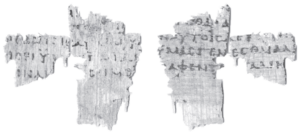
“The greatest literary problem in the New Testament is: What is the matter with the Gospel of Mark? Something happened to the end of it.” (Croy, 11)
Three of the four Gospels have happy endings. Jesus appears to his disciples after his resurrection then he gives them the Great Commission (Matthew) or he ascends to heaven (Luke) or he reinstates Peter (John).
But Mark is different. Although he includes a resurrection announcement: “You are looking for Jesus the Nazarene, who was crucified. He has risen! He is not here” (16:6 NIV), his Gospel ends without a resurrection appearance and his final scene highlights fearful and confused women fleeing from the empty tomb: “Trembling and bewildered, the women went out and fled from the tomb. They said nothing to anyone, because they were afraid” (16:8).
If you read the King James Bible, you may be thinking, “That’s not how Mark ends! What about Mark 16:9-20?”
9 When Jesus rose early on the first day of the week, he appeared first to Mary Magdalene, out of whom he had driven seven demons. 10 She went and told those who had been with him and who were mourning and weeping. 11 When they heard that Jesus was alive and that she had seen him, they did not believe it.
12 Afterward Jesus appeared in a different form to two of them while they were walking in the country. 13 These returned and reported it to the rest; but they did not believe them either.
14 Later Jesus appeared to the Eleven as they were eating; he rebuked them for their lack of faith and their stubborn refusal to believe those who had seen him after he had risen.
15 He said to them, “Go into all the world and preach the gospel to all creation. 16 Whoever believes and is baptized will be saved, but whoever does not believe will be condemned. 17 And these signs will accompany those who believe: In my name they will drive out demons; they will speak in new tongues; 18 they will pick up snakes with their hands; and when they drink deadly poison, it will not hurt them at all; they will place their hands on sick people, and they will get well.”
19 After the Lord Jesus had spoken to them, he was taken up into heaven and he sat at the right hand of God. 20 Then the disciples went out and preached everywhere, and the Lord worked with them and confirmed his word by the signs that accompanied it.
The majority of New Testament scholars today do not believe Mark 16:9-20 was included in Mark’s original Gospel. Why? These verses are not found in the earliest Greek manuscripts, the style is different from the rest of Mark, it breaks the flow of Mark’s narrative, and the testimony of some ancient church fathers. As a result, most modern English versions include something like the following statement prior to Mark 16:9-20: “The earliest manuscripts and some other ancient witnesses do not have verses 9–20.” And that means, as far as we know, Mark ends in fear and silence.
Or does it?
Let’s take a closer look.
Manuscript Data
We do not have the original version or the autograph of any biblical book. Instead we have many copies. In Mark’s case, we have more than 1,600 copies in Greek, the original language, and no two manuscripts are identical. So how do the copies of Mark end?
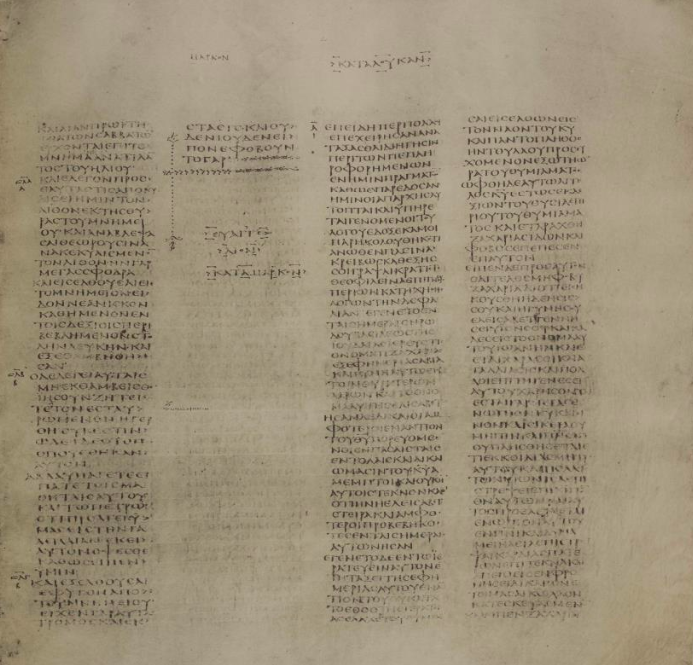
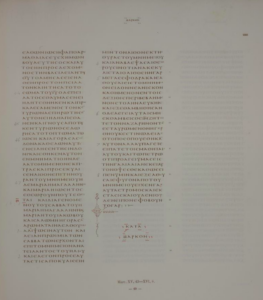
Two important Greek manuscripts—Codex Sinaiticus (ℵ) and Codex Vaticanus (B)—end at 16:8. In the world of textual criticism, these are heavy hitters because they are the earliest complete Greek manuscripts of Mark, dating to the fourth century. Mark 16:8 is followed by blank space in the images below.
Miniscule 304 from the 12th or 13th century also ends at 16:8, but its witness is not nearly as significant because it’s late and it’s a commentary interspersed with the Gospel text. So the comment that “The earliest manuscripts . . . do not have verses 9–20” is primarily referring to two manuscripts—Codex Sinaiticus (ℵ) and Codex Vaticanus (B).
Next we have manuscripts with this statement following 16:8:
They reported briefly to those around Peter all that they had been commanded. After these things Jesus himself sent out through them, from the east to the west, the holy and imperishable preaching of eternal salvation. Amen.
This statement, known as the Shorter Ending, appears with and without the “Amen” along with other minor variants, but the substance is the same. Only one manuscript (k) contains this ending alone. James Snapp says, “Eight Greek manuscripts have the so-called Shorter Ending . . . And all eight proceed to include 16:9 (a few of these eight manuscripts are fragments which, due to damage, do not have all twelve verses).” “All twelve verses” refers to Mark 16:9-20. In other words, the Shorter Ending usually flows into the Longer Ending—16:9-20.
Lastly, the vast majority of Greek manuscripts include Mark 16:9-20. According to Snapp, the total number of manuscripts with the Longer Ending is 1,653. Granted, most of these manuscripts are medieval and therefore late, but some are early, such as the following codices, which date to the fifth century: Alexandrinus (A), Ephraemi rescriptus (C), Bezae (D), Cyprius (K), and Washingtonianus (W). Washingtonianus is unique in adding an interpolation, known as the Freer Logion, between verses 14 and 15:
And they excused themselves, saying, This age of lawlessness and unbelief is under Satan, who does not allow the truth and power of God to prevail over the unclean things dominated by the spirits. Therefore, reveal your righteousness now. — thus they spoke to Christ. And Christ responded to them, The limit of the years of Satan’s power is completed, but other terrible things draw near. And for those who sinned I was handed over to death, that they might return to the truth and no longer sin, in order that they might inherit the spiritual and incorruptible heavenly glory of righteousness.
Summary of Manuscript Data
In sum, here’s the overall manuscript evidence for Mark’s ending:
- 16:8 – two 4th century manuscripts and one medieval manuscript
- The Shorter Ending (usually combined with the Longer Ending) – eight manuscripts
- The Longer Ending (16:9-20) – 1,653 manuscripts with some dating to the fifth century
Things are a bit more complicated than this with a variant here or there, but this is the big picture. Zooming out we can see that more than 99.8% of extant Greek manuscripts contain the Longer Ending. Keep in mind that all knowledge of manuscripts is provisional because we have only discovered a fraction of the total number.
How can we determine the original wording from the extant manuscripts? The art and science of textual criticism is based on certain canons or principles. For example, the shorter reading is to be preferred because it’s more likely that a scribe would add text than remove it, especially large portions like the Longer Ending. And earlier manuscripts carry more weight because there was less time for changes to develop. Hence, even though the vast majority of manuscripts contain the Longer Ending, we should go with the earliest manuscripts.
Tatian (c. AD 120-180)
While living in Syria, Tatian compiled the Diatessaron, which means “out of four.” This is a harmony of the four Gospels written in Syriac around AD 170. Since the original no longer survives, the text has been reconstructed from translations and commentaries. Does the Diatessaron incorporate Mark’s Longer Ending? This text below appears to be a direct quote from Mark 16:16-18:
For whosoever believeth and is baptized shall be saved; but [9] whosoever believeth not shall be rejected. And the signs which shall attend those that believe in me are these: that they shall cast out devils in my name; and they [10] shall speak with new tongues; and they shall take up serpents, and if they drink deadly poison, it shall not injure them; and they shall lay their hands on the diseased, [11] and they shall be healed. (Section LV)
In his comparison of two copies of the Diatessaron, Nicholas Zola concludes:
Irenaeus (c. AD 130-202)
In Against Heresies, written around AD 180, Ireneaus gives a significant statement on Mark’s ending:
Also, towards the conclusion of his Gospel, Mark says: “So then, after the Lord Jesus had spoken to them, He was received up into heaven, and sitteth on the right hand of God; ” confirming what had been spoken by the prophet: “The Lord said to my Lord, Sit Thou on My right hand, until I make Thy foes Thy footstool.” (3.10.5)
Irenaeus, then, believed Mark’s ending continued beyond 16:8. And the content of his statement supports the Longer Ending. Irenaeus writes, “towards the conclusion of his Gospel” then he quotes the penultimate verse from the Longer Ending. Here are the last two verses of the Longer Ending:
19 After the Lord Jesus had spoken to them, he was taken up into heaven and he sat at the right hand of God. 20 Then the disciples went out and preached everywhere, and the Lord worked with them and confirmed his word by the signs that accompanied it.
Eusebius (c. AD 260-339)
With Eusebius we are traveling 4200 kilometers (2609 miles) away from Irenaeus—from Lyon, France to Caesarea Maritima, Israel—and more than a century later. In response to an apparent discrepancy between Matthew and Mark, Eusebius (c. 260-340) offers two possible answers:
The actual nub of the matter is the pericope which says this. One who athetises [marks the passage as spurious] that pericope would say that it is not found in all copies of the gospel according to Mark: accurate copies end their text of the Marcan account with the words of the young man whom the women saw, and who said to them: “‘Do not be afraid; it is Jesus the Nazarene that you are looking for, etc. … ’ ”, after which it adds: “And when they heard this, they ran away, and said nothing to anyone, because they were frightened.” That is where the text does end, in almost all copies of the gospel according to Mark. What occasionally follows in some copies, not all, would be extraneous, most particularly if it contained something contradictory to the evidence of the other evangelists. That, then, would be one person’s answer: to reject it, entirely obviating the question as superfluous. (Gospel Problems and Solutions, 97)
The first answer, then, for Eusebius is that “accurate copies end their text of the Marcan account” at 16:8. “That is where the text does end, in almost all copies of the gospel according to Mark.” But Eusebius acknowledges that “some copies” contained a longer ending.
Eusebius’s comments provide insight into Mark’s ending, but we must contextualize his perspective as we must for every ancient author. Eusebius lived more than a millennium before the invention of the printing press. In this setting no standard production facility for books existed. Books could only proliferate by being hand-copied, which took a great deal of time and money. And sending them to other locations also required significant resources. Therefore, access to these manuscripts was limited. Hence, Eusebius and every other ancient person who mentions manuscripts, can only be referring to the small number they were aware of.
Here is Eusebius’s second solution:
Another view, from someone diffident about athetising anything at all in the text of the gospels, however transmitted, is that there is a twofold reading, as in many other places, and that both are to be accepted; it is not for the faithful and devout to judge either as acceptable in preference to the other. (99)
The second solution, then, is to accept both endings of Mark.
Jerome (c. AD 342-420)
In addressing the same question that Eusebius answers, Jerome responds in a similar way in his Letter to Hedibia (c. 400 AD), probably written from Bethlehem, Israel:
Here you ask first why Matthew said that, “But when the evening of the Sabbath had begun to dawn, on the first day of the following week the Lord rose again”, and Mark relates that his resurrection happened in the morning, thus writing, “However when he rose again, on the first day of the week, in the morning Mary Magdalen arrived, from whom he had expelled seven demons: and she departing announced to those who were mourning and weeping with her. And these hearing that he was alive, and that she had seen him, did not believe in him”.
The solution of this question is two-fold; for either we do not accept the testimony of Mark, that is carried in few gospels, almost all the books of Greece not having this passage at the end, especially and since it seems to speak various and contrary things to the other evangelists; or this must be replied, that both speak truly: Matthew, when the Lord rose again on the evening of the Sabbath, Mark however, when Mary Magdalen saw him, that is, on the morning of the first day of the week.
Jerome’s answer is so similar to Eusebius’s that some think he is relying solely on Eusebius here. Again, we are given two possible solutions: reject the end of Mark because “almost all the books of Greece” don’t contain “this passage at the end,” or accept that both Matthew’s ending and Mark’s longer ending “speak truly.” Note that both Eusebius and Jerome use the phrase “almost all” in reference to the number of manuscripts that do not have the Longer Ending.
“That is where the text does end, in almost all copies of the gospel according to Mark.” (Eusebius)
“almost all the books of Greece not having this passage at the end” (Jerome)
Hence, while we have two major early manuscripts that end at 16:8, Eusebius and Jerome knew of, or at least heard of, many more.
Ambrose (c. AD 339-397)
Moving to Italy, Ambrose, bishop of Milan, quotes Mark 16:17-18:
He gave all gifts to His disciples, of whom He said: In My Name they shall cast out devils; they shall speak with new tongues; they shall take up serpents; and if they shall drink any deadly thing it shall not hurt them; they shall lay hands on the sick, and they shall do well.
(On Repentance, 1.8.35)
Augustine (c. AD 354-430)
A little later, Augustine, in north Africa, writes the following in his Harmony of the Gospels:
The latter evangelist [Mark] reports the same incident in these concise terms: And after that He appeared in another form unto two of them, as they walked and went to a country-seat. . .
Again, if Mark tells us that the Lord appeared to these persons in another form, Luke refers to the same when he says that their eyes, were holden, that they should not know Him.” (3.25.71-72)
Augustine is referencing Mark 16:12 showing his awareness and apparent approval of Mark’s Longer Ending: “Afterward Jesus appeared in a different form to two of them while they were walking in the country.”
Summary of Church Father Data
Evidence from the church fathers cannot take us back far enough to shed light on Mark’s original ending. With Tatian we reach to the mid-second century—about a century after Mark wrote his Gospel. Here’s what we know from the church fathers:
- The Longer Ending was a part of Mark’s Gospel as early as the mid-second century.
- The Longer Ending was found in manuscripts that spread throughout the Roman Empire during the first four centuries. Our short survey took us to from Syria to France to Israel to Italy and to north Africa, but many more places could have been mentioned.
- The Longer Ending appears to have been accepted without hesitation by several early church leaders.
- According to two fourth century church fathers (Eusebius and Jerome), “almost all” copies of Mark or “almost all the books of Greece” did not have the Longer Ending. Hence, while the Longer Ending was widespread, there must have been many other copies that ended at 16:8.
For more information on the data from manuscripts and church fathers, see the textual commentary by Wieland Willker.
Internal Evidence for 16:8
Mark’s ending at 16:8 is baffling for three reasons. First, it doesn’t match how the good news of Jesus was preached by others in the New Testament. The good news includes the following core items: Jesus’ life, death, resurrection, and appearances. We see this established sequence in the other three Gospels, Acts, and Paul’s letters. According to Eusebius, who says he is relaying information from Papias (c. AD 60-130), Mark accompanied Peter and he wrote his Gospel based on what he had heard from Peter. If that is accurate, Mark would have heard this gospel sequence repeatedly. If Mark was being graded on how well he adhered to the standard gospel format, he would get a C because he didn’t include resurrection appearances.
Second, Mark’s narrative leads his audience to expect an appearance of Jesus in Galilee:
Before his death, Jesus told his disciples, “But after I have risen, I will go ahead of you into Galilee.” (14:28)
And the young man at the tomb reiterated this promise to the women: “But go, tell his disciples and Peter, ‘He is going ahead of you into Galilee. There you will see him, just as he told you.’” (16:7)
How, then, could Mark end without including the fulfillment of this promise? Doesn’t ending with 16:8 subvert the trajectory of his narrative? Moreover, leaving a prediction hanging in mid-air is inconsistent with Mark’s style. Robert Gundry lists the following examples of prediction and fulfillment in Mark:
- finding a colt (11:2-6),
- meeting a man carrying a jar of water (14:13-16),
- Jesus’ betrayal (14:18-20, 43-45),
- the scattering of the disciples (14:27, 50),
- Peter’s denial of Jesus (14:30-31, 66-72), and
- Jesus’ suffering and death (8:31; 9:31; 10:32-34).
How could Mark end his Gospel with the key and final prediction suspended in the stratosphere?
Third, in Greek, the last two words of 16:8 are ephobounto gar meaning “they were afraid for” or reordering the words, “for they were afraid.” There are instances where an ancient Greek work ends in gar (for), but it’s rare, not found in narratives, and never in the New Testament, which has more than 1,000 uses of gar. In the New Testament gar is always followed by a phrase. This includes almost 70 uses of gar in Mark. In other words, if Mark ended his work with gar, he did something unprecedented in ancient Greek narratives, the New Testament, and his own work.
Some have speculated that Mark was writing ahead of his time by ending his Gospel in an open-ended way. Perhaps his Gospel is like a Gospel Noir, inviting readers to add their own ending to the story or to deeply reflect on themselves. This is a popular view today, but I don’t think it’s correct. Instead I agree with this statement:
To suppose that Mark originally intended to end his Gospel in this way implies both that he was totally indifferent to the canons of popular storytelling, and that by pure accident he happened to hit on a conclusion which suits the technique of a highly sophisticated type of modern literature. The odds against such a coincidence (even if we could for a moment entertain the idea that Mark was indifferent to canons which he observes scrupulously elsewhere in his Gospel) seem to me to be so enormous as not to be worth considering. (W.L. Knox, HTR, The Ending of St. Mark’s Gospel)
In his book, The Mutilation of Mark’s Gospel, N. Clayton Croy explains the sea change in scholarly opinion on this matter, which he says occurred around 1970 with a new kind of literary analysis known as New Criticism. He says in previous generations the majority view was that Mark’s conclusion was somehow mutilated, but many today think Mark intended to end his Gospel at 16:8 (13). I guess I fit with the older generation.
For me the final gar is convincing proof that Mark didn’t intend to end his Gospel at 16:8. Consequently, although my Greek is rusty, I think we should leave the translation as “they were afraid for” showing how Mark’s Gospel abruptly and strangely ends.
So what happened to Mark’s final words? Some have speculated that the abrupt ending was due to persecution, causing Mark to suddenly stop writing. Others think the last leaf of his codex was damaged, causing the ending to fall into oblivion. Since persecution was sporadic, I think the latter suggestion is more likely. But did Mark write on a codex, the precursor to the book, or on a scroll? We can’t say for certain, but we do know the first Christians were enthusiastic users of the codex. If he used a scroll, it’s possible the scroll was damaged as well.
Internal Evidence for 16:9-20
The Longer Ending mentions three resurrection appearances, followed by a commissioning to go and preach, followed by Jesus’ ascension and seating at God’s right hand. This basic structure aligns with other Gospels and the preaching in Acts, but some details are unusual:
- No mention is made of Galilee where the disciples were supposed to see Jesus (see 14:28; 16:7).
- Mary Magdalene is introduced as the one “out of whom he had driven seven demons” (v. 9), but Mary Magdalene has already been mentioned in verse 1 of the same chapter with just her name. Why is the author explaining who she is at this point?
- Unlike the other Gospels, it doesn’t narrate resurrection appearances, but it does mention them.
- It calls Jesus’ followers, “those who had been with him” (v. 10), but that phrase is not used for the disciples in Mark.
- Verses 17-18 contain the only reference to speaking in tongues, picking up snakes, and drinking deadly poison in the Gospels.
- It seems to be a patchwork of elements from other Gospels:
-
- Jesus appeared first to Mary Magdalene (Jn 20:11-18),
- Mary Magdalene was delivered from seven demons (Lk 8:2),
- Jesus appeared to two walking in the country (Lk 24:13-35),
- Jesus rebuked the disciples for their lack of faith (Lk 24:25),
- Jesus gives a commission to the disciples (Mt 28:18-20),
- Jesus ascends to heaven (Lk 24:50-53).
The unusual features along with the textual data lead me to think the Longer Ending wasn’t written at the same time as Mark 1:1-16:8. In other words, as most modern scholars think, it’s probably a secondary addition. This doesn’t mean the Longer Ending is inaccurate. In fact, as we have seen, much of it matches with other Gospels. It just means it was written later than the original book of Mark. So who wrote it? My guess is that it wasn’t written by Mark, but I have no idea who wrote it. Why was it written? Someone or some group thought the Gospel didn’t properly end with 16:8 so they added more information.
Mark’s Actual Ending
If Mark’s Gospel didn’t end at 16:8 and the Longer Ending wasn’t written by him, how did it end? Unless we discover more ancient manuscripts, we cannot answer this question with a high degree of confidence. However, we can compare Mark with three other books of the same genre and time period to get an idea of what he might have been thinking. The point of comparison is the women leaving the empty tomb and what happens next.
Trembling and bewildered, the women went out and fled from the tomb. They said nothing to anyone, because they were afraid. (Mk 16:8)
So the women hurried away from the tomb, afraid yet filled with joy, and ran to tell his disciples. Suddenly Jesus met them. “Greetings,” he said. They came to him, clasped his feet and worshiped him. Then Jesus said to them, “Do not be afraid. Go and tell my brothers to go to Galilee; there they will see me. . . Then the eleven disciples went to Galilee, to the mountain where Jesus had told them to go. When they saw him, they worshiped him; but some doubted. Then Jesus came to them and said, “All authority in heaven and on earth has been given to me. Therefore go and make disciples of all nations, baptizing them in the name of the Father and of the Son and of the Holy Spirit, and teaching them to obey everything I have commanded you. And surely I am with you always, to the very end of the age.” (Matt 28:8-20)
When they [the women] came back from the tomb, they told all these things to the Eleven and to all the others. It was Mary Magdalene, Joanna, Mary the mother of James, and the others with them who told this to the apostles (Lk 24:9-10). Luke continues by narrating Jesus’ appearance to the two walking to Emmaus, his appearance to the disciples, and his ascension.
Early on the first day of the week, while it was still dark, Mary Magdalene went to the tomb and saw that the stone had been removed from the entrance. So she came running to Simon Peter and the other disciple, the one Jesus loved, and said, “They have taken the Lord out of the tomb, and we don’t know where they have put him!” . . . On the evening of that first day of the week, when the disciples were together, with the doors locked for fear of the Jewish leaders, Jesus came and stood among them and said, “Peace be with you!” After he said this, he showed them his hands and side. The disciples were overjoyed when they saw the Lord. Again Jesus said, “Peace be with you! As the Father has sent me, I am sending you.” And with that he breathed on them and said, “Receive the Holy Spirit. If you forgive anyone’s sins, their sins are forgiven; if you do not forgive them, they are not forgiven.” (Jn 20:1-23) John continues by narrating an appearance to Thomas and an appearance to seven disciples in Galilee.
I have highlighted Galilee because two other Gospels include resurrection appearances in Galilee, which matches with Mark’s announcement of resurrection appearances in Galilee (14:28; 16:7). It’s possible, then, that Mark wanted to end his Gospel with a resurrection appearance in Galilee. This would make Luke the oddball because he doesn’t mention a Galilean appearance. Also, Mark probably would have included some kind of commissioning as we see in the other three Gospels. And maybe he would have mentioned Jesus’ ascension to heaven and seating at God’s right hand as Peter preached in Acts. Hence, Mark’s actual ending probably would have included key elements found in the Longer Ending with the addition of a spotlight on Galilee, and perhaps an absence of the strange elements—picking up snakes, drinking deadly poison, etc. Overall, then, the Longer Ending probably isn’t widely inaccurate; it just lacks a resurrection appearance in Galilee and contains some unusual elements.
In conclusion, the evidence points to this: Mark 16:8 is not Mark’s original ending but neither is Mark 16:9-20.
After graduating from Gordon-Conwell Theological Seminary, I served as a Bible and theology teacher in Asia and the U.S. My new book explores the amazing doctrine of the Trinity.
Discover more from BibleBridge
Subscribe to get the latest posts sent to your email.
Thanks Les… This exceptional information almost non existent in my experience as a Christian. reader. Pastors almost never go there because most people (having already made up their minds about how to interpret the Bible)… are not very interested}. Evangelists naturally would rather focus on salvation as the subject. I am not complaining let alone judging. This is just the way it seems to be. That leaves just us Christians with inquiring minds nowhere to go for information. Another problem is there are percentagewise…far more atheist writers analyising the Gospels for the purpose of destroying Christianity than honest writers like you who try to understand the truth from the available evidence! How many followers/readers you have are blessed indeed. I believe it would be many more if they knew about you. I don’t remember…. (years ago)… how I came across your site but I know it was a blessing from God. I have referred many friends and members of my own family to your site but I don’t know if any or how many have been blessed as I have ! (see above) Will M
Will, you are my most encouraging reader. I’m glad you have been blessed by my writings. I wasn’t planning on writing about the end of Mark, but a professor recommended a book to me and that book led me down this path for a few days.